
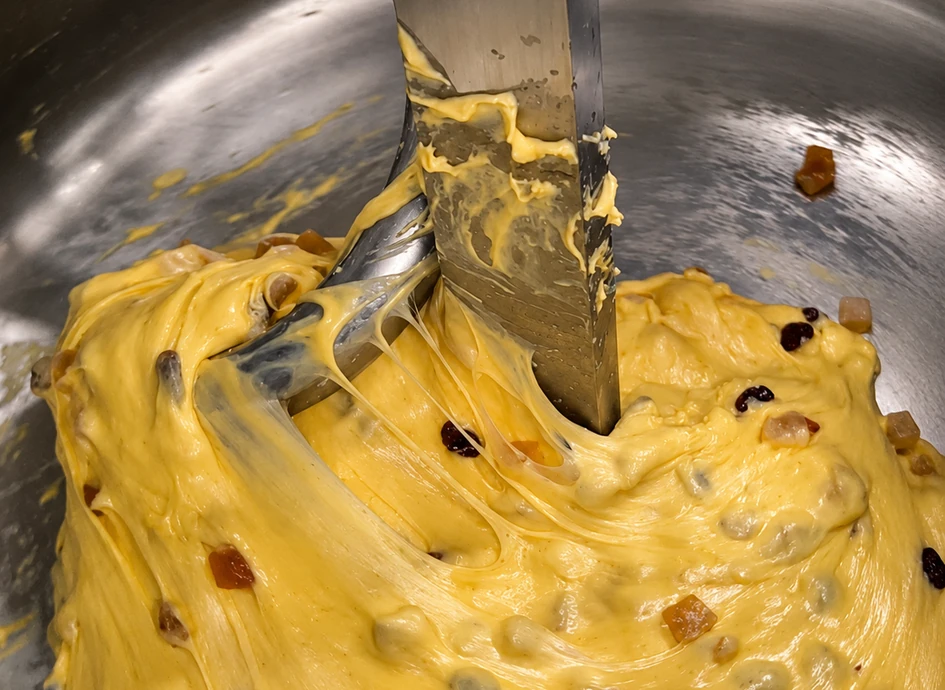
In the middle of the leavened cake season, how often does the dough come out of the bowl warmer than you wanted?
It is the most persistent technical problem of this production, and it has little to do with the weather: it has to do with how the mix is built. Panettone calls for long mixes, strong flours and a structure that has to carry butter, eggs and sugar. Every minute of mixing adds heat, and the margin is narrow.
Final dough temperature is what decides the outcome
For panettone, technical sources converge on a narrow window: a final dough temperature of around 25°C, and in any case never above 27-28°C.
Past that threshold the dough overheats, the gluten network gives way and the mass tears. It is not a recoverable mistake: what is lost in the bowl is not recovered during fermentation or in the oven.
These are process parameters, not machine specifications: they apply to whatever mixer you have in the bakery. What changes from one machine to another is how much control you have over them.
The heat comes from inside the bowl
Heat does not come from the room, it comes from the mixing itself.
A spiral works the dough through friction, and friction produces heat. It is the same mechanism that builds the gluten network: the energy that gives the dough its structure also warms it.
This is why the most demanding work — strong flours, long mixes, large leavened doughs — is also the work that heats up the most.
Controlling temperature therefore comes down to three things: knowing where you are, being able to change pace, and being able to repeat tomorrow what worked today.
Read it, adjust it, repeat it
Read it
The IR probe (IR TEMPERATURE READER, available as an option on the dedicated control panels) measures dough temperature during the mix. You know where you are while you work, without stopping the bowl for a manual reading.
Adjust it
The inverter speed regulator (INVERTER SPEED REGULATOR, optional) lets you vary the working speed. Slowing down through the more delicate phases is one of the direct levers on friction, and therefore on the heat that builds up.
Repeat it
With PROGRAM SETTING — a PLC colour touch screen panel, optional (not available on the ONE version) — you can store up to 99 recipes of 10 steps each. This means the result stops depending on who is on shift.
Cooling itself remains the baker’s call: cold water or pauses in the mix. The machine does not cool the dough, but it puts you in a position to measure and make corrections along the way.
Strong flours and demanding doughs: what the drive changes
Panettone is intensive, prolonged work. It is the ground the SUPREME version was built for: two motors and an indirect drive, designed to reduce strain on the most demanding mixes and with strong flours.
The difference is mechanical, and it has a practical consequence: through the long phases the drive works under less stress, and production stays continuous even on the busiest days of the season.
There is also a figure that separates the versions in terms of working range: SUPREME and GOLD can handle doughs down to around 55% hydration, while UNIMIX and ONE stop at around 60%. This is not a parameter of panettone itself — it is an enriched dough, not necessarily a dry one — but it points to a particularly valuable capability of the machine. For a bakery producing both large leavened cakes and stiff doughs in the same season, that is extra operating room.
A working method for the season
Five points that hold for every mix of the season:
1. Set your target final temperature before you start, not once the mix is running.
2. Keep an eye on the starting temperature of water and room: they determine the margin you have left.
3. Measure temperature during the mix, not only at the end.
4. Use speed as a lever, slowing down where the work is most delicate.
5. When you find the right combination of parameters, save it and reuse it. It is the only way to stop the result depending on the shift.
Test it on your own recipe
How a spiral behaves on panettone can only be understood so far from a spec sheet. It is properly understood the moment you mix your own recipe.
At WAICO LAB in Isola Vicentina you can test Effedue spiral mixers with your own doughs, your own recipes and your own production parameters, alongside our technical team. The trial is free, by appointment.
Book your trial: effedue-waico.com/waico-lab
Panettone goes through other stages too. The full chain, from mixing to baking: [Panettone, stage by stage].
FAQ
What is the final dough temperature for panettone?
Technical sources converge on a final temperature of around 25°C, and in any case no higher than 27-28°C. Past that threshold the gluten network gives way and the dough tends to tear.
Why does dough heat up in a spiral mixer?
Because the spiral works the dough through friction, and friction produces heat. It is the same mechanism that builds the gluten network: longer mixes and strong flours are also the ones that heat up the most.
How do you stop panettone dough from getting too warm?
On three fronts: measure the temperature during the mix, adjust the speed to contain friction, and cool the ingredients with cold water or with pauses. The mixer lets you measure and adjust; cooling remains the baker’s call.
What is the difference between the UNIMIX and SUPREME versions?
SUPREME has two motors and an indirect drive, designed to reduce strain on intensive mixes and with strong flours. On working range, SUPREME and GOLD run from around 55% hydration, while UNIMIX and ONE start at around 60%.
Can the mixers be tested before buying?
Yes. At WAICO LAB in Isola Vicentina you test with your own doughs, your own recipes and your own production parameters, alongside the technical team. The trial is free, by appointment.